Showing posts with label uttar pradesh. Show all posts

Sunday, August 7, 2011

Conversations on the road

If you haven't guessed already, I've been away. 5 districts in two states, and I haven't processed it all. The landscapes, of rural UP and the Himalayas were stunning enough to make me gasp for pleasure. This was a work tour, and my colleague and I were hosted by extremely passionate and committed people. We saw wonderful work being done, and magnificent restored forests. At the same time, there was much to distress me- xenophobia, untouchability, smugness. Great joy, great sadness, and I still need to sort through my photos, notes and memories. Till then a conversation:

Me (hunting for um, feminine products at a junction town): Hello Bhaisaab. Do you have Kotex?
He: (Blank stare)
Me (getting a little desperate because my colleagues might turn up) : Um. Kotex? Stayfree? Whisper?
He: What are those?
Me: Sanitary napkins. Do you have any?
He: What are those? Something to do with a camera?

There were many responses possible to that statement. A short sex-ed class might have been called for. I could have said,'It could be, but that's way too kinky for me'. I chose the coward's way out.

 'No. Thank you anyway.'


Tuesday, May 11, 2010

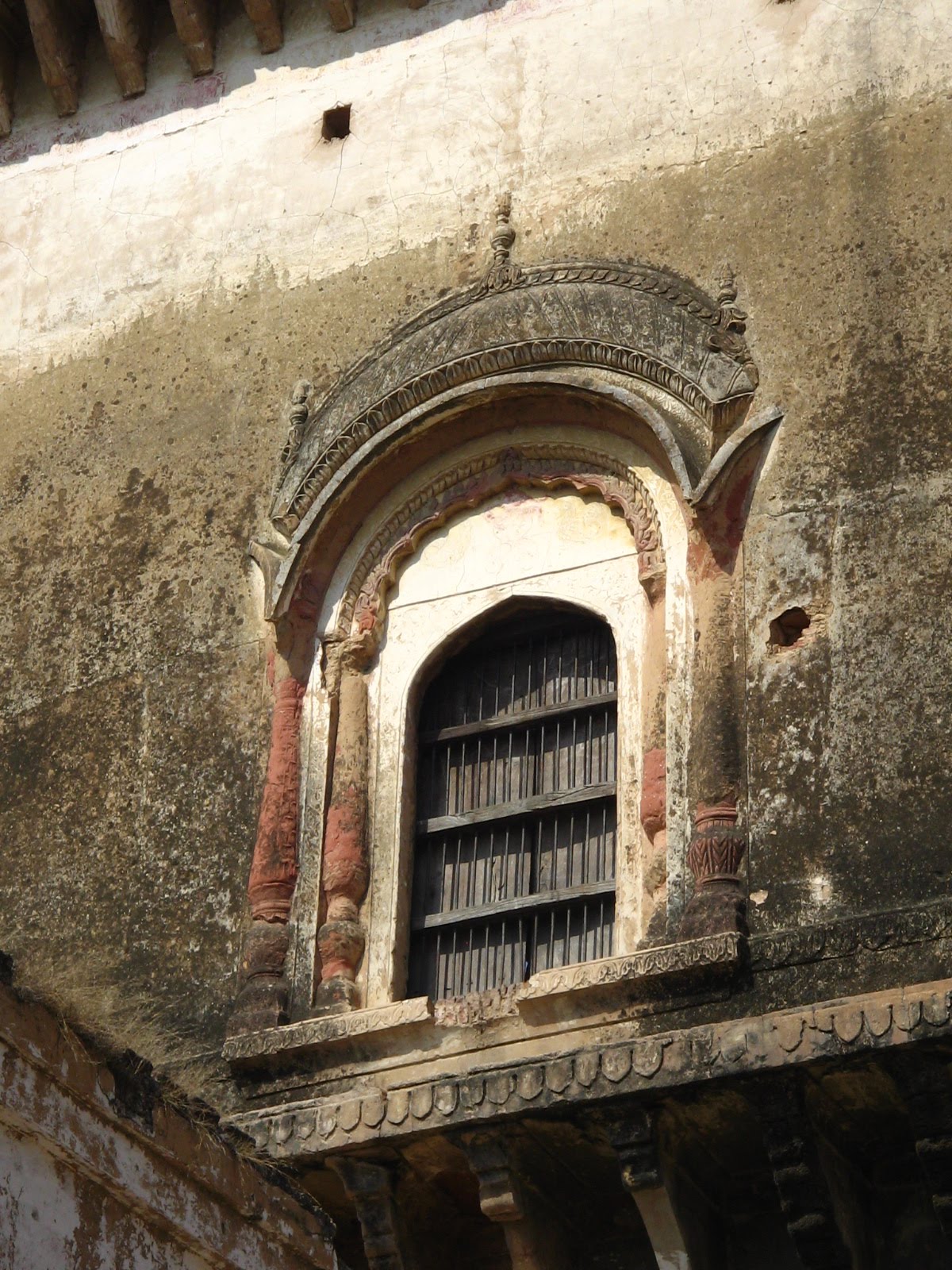
Bithoor and its buildings

When I was complaining about the lack of urban art in Dehradun, W told me," keep your eyes above street level'. and that was sound advice.
It is largely the ground floor facades that are papered/panelled/torn down. The upper storeys of old buildings are not considered for 'modernization' and retain a lot of their charm.
And that is also true of Bithoor, where it is notmodernization but grafitti that is defacing many lovely buildings.
but the upper stories still retain a dignified beauty.


and sometimes, it is not just the beauty of a building, but a hint of what it conceals that is so tantalizing.

Wednesday, March 24, 2010

Kanwadiya

I had mentioned the Kanwad mela fleetingly earlier, and had promised you a fuller write-up. It took me a year and another mela, but here we are.

The event:
Every year in the month of Shravan(jul-Aug) and during Shivratri (in Feb)*, millions of people come to the Ganga to carry water back to the temples in their towns. This water is used to anoint Shiva, who presumably would otherwise feel neglected by Ganga. The name for the Mela comes from the bamboo yokes that people use to carry the water in. The pilgrims are called Kanwadiya while their Kanwads (kanvad, kaanvad) are carried on their shoulders. Both can be seen in the picture below.

The Rules: Traditionally people walk to and from their villages, either fasting or living on an austere diet of fruit and milk. The Kanwad with its precious load is not supposed to be set down on the ground, and so teams take shifts, or rest propped up against trees and posts. Haridwar is the most popular place to carry water from, but we also saw a great many pilgrims at 'lesser' ghats like Soron and Bithoor.

The Loopholes: where there are humans, there must be loopholes, no? and so now many kanwadiyas travel by cycles, motorcycles or in vans. Judging from the vast arrays of sticky fried foods at Bithoor, kanwadiyas now no longer restrict themselves too much- though no meat still is important. There are other changes too, largely to do with the focus of the mela and is dealt with here .

The Good: The mela is a good way to bring the river into focus, when it is usually sidelined by temples and assorted gods. Repeat visits to the river help create awareness of the threats to it. Some of the most aware respondents we met were kanwadiyas. Once a male-only event, increasing numbers of women are participating in it.

The Bad: The mela is being usurped by youth groups looking for a good time in the name of religion. These groups largely come in the vans, a phenomenon known as 'Dak Kanwad' - the postal kanwad, a reference to the speed at which they travel. Flush with the arrogance of surging hormones and the holier-than-thou attitude of pilgrims, they essentially go on a rampage. Rash driving, 'shopping' without paying for goods, traveling ticketless and beating up people are the norm, and there is very little the police can do, assuming they are willing to 'interfere in religious matters'.

The Ugly: Pollution. Look at the picture below.

The Beautiful: I didn’t want to end on a negative note, and anyway I wanted to share these things with you.
These are the bottles in which the Kanwadiyas carry water home. Beautiful, fragile, hand-blown, multicoloured bottles at Re 1/- each. I bought 5 and carried them home scarcely daring to breathe on them.

The kanwads themselves. These are lavishly (and to be honest, garishly) decorated by the pilgrims with ribbons, braid, sequins, plastic peacocks (!) and foam rabbits (!!). There is something sweet in watching these tough men debating the virtues of a pink bunny over a yellow one. There is regional variation in the decoration, and the one below is at Bithoor. For a view of the bunnies in vogue at Soron, look at the second photo in this post.
For a lot of the pilgrims, this was a way of reconnecting with their soil and their friends. One of the people I spoke with worked in a mill in Surat. Every couple of years, he and a friend took enough leave to walk remembered paths together and perform a small service for their village deity.

* Thank you very much, Kavita, for pointing this out.

Tuesday, March 16, 2010

India.

I have spoken about the heart-breaking poverty and social injustice in Kachla and Bithoor.

And at first glance, a little habitation I came across in Kachla seemed the embodiment of these two things. The vulnerability of the houses to the elements and their decidedly unhealthy location next to a stagnant pond shocked me. The houses arein the floodplain (next to the river bed, in fact) of one of the largest rivers in the world,and I thought of how the floods must impact these households for three months of the year, every single year. Having spoken to the other respondents, I now had a sense of the utter injustice they face every day. All that the Government claims to provide for its citizens- right to employment, right to primary education, right to health, and even the most basic right to life- is denied these families. The lack of a door for the house is poignant in its admission of having nothing to lose.

But then I was struck by how houseproud the family is. There are times when my house is not as neat as this courtyard. The floor is clean, the refuse has been disposed off out of sight, and the bedding is soaking in the sun. I do not intend to romanticise poverty, but to point out that dignity has nothing to do with externalities.

And above all, quite literally, flies the national tricolour. The nation has failed this family and a million such families-and still they are proud of it. I crib in public because I am having difficulties with registration.

I wish now that I had walked up to this woman, spoken with her, asked her of the flag. But on the other hand, maybe it is good that I didn't..

Saturday, March 6, 2010

On piety in Kachla

It is a pretty pious place, I have to admit.

I might be too cynical (and too aware of pollution issues) to actually bathe like the woman above, but I have to admit to great beauty.

And when I look across the plains and reflect that people have been praying here for centuries, I also am moved to reflection.

and it is not just humans, apparently this impulse moves monkeys too.

But not mynahs, who seek no more than to lurk in the shade and look for food. And yes, have a rollickin' social time when at it.

and certain surveyors are moved more to Art than contemplation..

Tuesday, March 2, 2010

Why I wouldn't live in Uttar Pradesh

Visiting, yes. Living, no.

And here is why..

There are far too many guns around. And people apparently don’t believe in discreet pocketable guns. Here, size does matter. And they are pretty nonchalant about that too..people roam the streets with ancient rifles carelessly tossed on their shoulders, and no one blinks an eye. No one, that is, except the two researchers with fraying nerves. Here is M trying to forget that she is asking sensitive faith-related questions of an armed crowd.

Nothing underlines the ubiquitous nature of the gun-culture in UP as the shops where they are sold. I am used to dedicated arms shops with 'no loaded guns allowed' signs posted everywhere, with lots of transparent glass and other security measures. But look at the shop below. Guns, mobiles, toys and cosmetics- something for the entire family.

And then there are the everyday experiences.
 In the few days that I spent there, I saw far too much misery. There are far too many underage mothers..including a grandmother who was not more than in her late thirties. It was clear when I spoke to the people that there is massive siphoning of government funds into private pockets. The meal a day, anganwadi, local schools nothing functions. And then there is the violence. Too many arguments are settled by fights. And for too many people, the options are just to hunker down and accept the blows.


On day three of our surveys, we decided that we haven’t spoken to enough farmers, and need to meet some of them. Now this being a pilgrimage spot, farmers were pretty rare. And so when B, one of my colleagues, saw a pair digging far across the plains, he dashed off to add them to his trophy bag, so to speak. As he was running towards them, he realised that their agricultural technique was a little unusual. One of them was taking snaps of the event while the other was burying the corpse of a young woman. Sadly for B, there is no cover on those wide, treeless plains, and so he didn’t have the option of suddenly changing course or diving for cover. And so he had no option but to keep running till he was close to them. They were hospitable enough, and did not seem to mind an unexpected observer. The corpse was that of a sixteen-year old girl, they said, daughter and sister to these two. B prudently refrained from asking such questions as why was the burial in non-consecrated soil far away from everywhere, why only two people, and why did they feel the need for documenting this. He said, ‘oh, sorry to disturb you at such a sad time’ and was turning around to sprint back, presumably much faster this time, when they insisted that he go over the questionnaire with them. Since he ran here from so far away, they said. And he did come back a little trembly but triumphant. Our reaction? We have enough funeral-participants! We need farmers!

Thursday, February 25, 2010

looking for more reasons to visit UP?

Because the railway station at Badaun, UP is beautiful

A chana-seller's cart, Badaun. I like this snap with the solitary, untended cart in front of a moving train crammed with travelers. And yes, I liked the chanas too. Buying five rupees worth of warm, freshly roasted gram and munching them with one's colleagues is a nice way to start the day.


And while eating, there was much entertainment to be had from the monkeys..here is one posing for a pretty picture.


Tuesday, February 23, 2010

Another reason to visit UP

Because no one has yet built a functioning time machine..

In UP, there happily co-exist several different eras. Cities like Bareilly and Kanpur are everyday urban areas with motorcycles, malls, multiplexes and mayhem. Travel a little beyond them though, and the visitor can pick and choose what decade s/he wants to experience.
Let's begin with movies. The latest Bollywood release being shown in Badaun was Damini, and doing pretty well, I expect. Only ..it was released in 1993. The last decade-and-a-half apparently never happened in UP.

And then, an astonishing amount of travel is carried out with muscle power-either human or animal.  You have met Basant earlier, and the only taxi-service available in Badaun were the cycle-rickshaws. I loved the way they were decorated.
I of course, photographed one that appealed to the romantic in me, but the predominant theme was macho-gun-wielding-hero. Here is an example.

This road that I traveled on from Soron to Lahare..

I took it to be one of those many ephemeral paths that get created one year to disappear the other. Till I saw these buildings, and realised that I was travelling on an old, old, important highway.
 The structure  in the photo is a rather handsomely built well that's part of a caravanserai. This particular caravanserai was only one of many such along the road, showing how important this route was. This is achingly Ozymandian, considering that I had never before heard of either village

On a happier note, I came across a horse-fair!

 The picture above is the only one I had that gives some idea of the bustle and fair-like atmosphere. But I initially hated it because of that motorbike smack front and centre. What was I thinking? Now however, I think it fits in well with the theme of this post, don't you?

I spoke with the owner of these horses. He had come from the West, he told me..from across punjab and Haryana. Well, in a scene from Kim, it is only fitting that I speak to Mahbub Ali!

Saturday, February 20, 2010

Why I would like to visit Uttar Pradesh again..

Because the people we met have been truly nice.
There are several other reasons, and I will talk of them all, but we need to start with the important things, don’t we?
The people we met in the course of interviews turned our assumptions about the uncouth badlands topsy-turvy. People gave up their seats for us, didn’t let us get lost, and threw themselves whole heartedly into our research and gave us tips and additional information. If they saw we were unsettled by anything, they immediately reassured us. Each of us was invited to a respondents home for a meal atleast once.This is remarkable anywhere, but more so here, where the living is so incredibly tough. The struggle-filled lives that everyone led matter-of-factly caused me to weep at times.
  • There was young Tulsi, exactly the same age as my niece. She had never been to school and now helped her brother run his chai stall. Soon, she would probably be married off. A bit of the child in her still shone through when she spoke of playing in the river.
  • There was the choodiyan seller with his sadhu friend. In that bustling pilgrim town, these two misfits, one a muslim and the other an exiled sadhu had found each othere.
  • Basant’s owner, posing with Basant in the picture. A one-armed tangawallah who was ecstatic when we paid him a bit more than the agreed price. Basant himself was the healthiest and most well-fed living being we had seen in that entire poverty-stricken area. His love for his master is very clear in the way he has turned his head to nuzzle him.
  • The Prasad-seller who was dreading Holi. She had no money to buy clothes for her family, she said. Every day she prayed to Ganga, “ kaise bhi karake dhak do inhe. Somehow, cover their bodies.” But she gifted a pedha apiece to three weary surveyors.

Wednesday, February 17, 2010

The Grand Trunk Road

I wanted to do this in chronological order, but how can I delay answering Nadi?

The Grand Trunk road then, is 2,500 Km of poetry. It has been a constant part of India through four empires (the Mauryan, the Mughal, the British, and democratic India). It is a river of life, a catalyst for trade, a creator of wanderlust, a fount of stories, an enabler of dreams, the physical manifestation of great travel.  It has been called  the Sadak-e-Azam, the Grand Trunk road, and even its modern, humdrum name reflects its importance: NH1.


I have read about it and lusted to travel its length. And so living in a hotel the front door of which opened out onto The Road is surely the best of locations. From there we saw trucks, buses, horse-carts, cycle rickshaws, pedestrians..If we chose we could have bought biriyani, dahi, jalebis, samosas, fruit, pots, chillums, rope, condoms*, electronics, clothes, marble. We quite literally inhaled the breadth of the sub-continent.


Which brings us to why it is the worst of locations. Living in the middle of the river of life is not a restful experience. It is always noisy, and gets noisier at night when trucks ply. I like the tunes they play on their horns, mind you, but not all night, every night. And they belch exhaust and churn the gangetic silt..


Wonderful for the travel experience, terrible for the rest it allows.


*I mention these because here I saw for the first time the vending machines actually being used. A government initiative to make condoms more accessible to high-risk groups, the vending machines are often sadly misused. Not here, where India's excellent outreach program has worked and the CVMs were sans grafitti and displayed in accessible areas.


Travelling in Uttar Pradesh

Now, I love to travel. A friend and I often joke that creating a map with little green flags to mark the places we want to visit wouldn't work for us..we would just have to get a spray can of paint and colour the entire globe green. That is not quite true. I have never had an urge to visit the Hindi heartland of India, The Darkness as Adiga calls it. So you can guess how excited I was when I began working on a project that requires travel here..
Where exactly is 'here'?

here's a map of where my colleagues and I spent a couple of weeks:

View travelling in Uttar Pradesh in a larger map

week 1: we travelled from Dehradun-Bareilly-Badayoon. We then stayed at the quite acceptable Tourist Guesthouse in Badayoon and commuted to Kachla ghat to conduct surveys.
week 2: We moved our base from Badayoon to Kalyanpur. We stayed in Kalyanpur (bang on the Grand Trunk Road, which is simultaneously the best and worst of locations) and commuted to Bithoor.
end of the 2nd week, we returned to Dun and enjoyed being cosseted by our families.

stories and photos follow. But here is a glimpse of 'India Shining ' UP-style..
young coin-collectors, kachhla bridge

Thursday, July 23, 2009

Aesthetic Sense

There is this..the Charbagh Railway station, Lucknow. Not exceptional, the helmet-like domes boggle the mind, and the paint is a trifle too new..but it does have a certain beauty, a patient, enduring grace if you will.


And then there is this. Why, why would a respected hotel choose to carpet it's meeting rooms with illustrations of stool samples during a roundworm epidemic? Welcome to the Taj Residency, Lucknow.

Tuesday, July 14, 2009

what I saw: Delhi-Dehradun

When we were children, we had a book called 'What I Saw'. The text on each page began with 'I saw, I saw' and described a little scene in a phrase or two. The main thing about the book were the lovely two-page illustrations by Mario Miranda. Lovely.

I am telling you this because the day before,I went to Delhi and back by car. I dont have stories, but a lot of images. Here we go ,then

I saw, I saw
• People. People who to my coastal-bred and reared eyes seemed as if they had stepped out of the pages of my geography text or of Geographical magazine. Crowded in markets, on the top of tankers, on carts drawn by assorted animals, home-made vehicles, cycles and on foot.
• The DIY vehicles. These are locally known as jugad (a term that means ‘sleight of hand’). All it takes to construct them is three wheels, some wood, and a diesel generator set. All else is optional. They are used as public transport and their easy acceptance on the roads of UP and Haryana is an ode to both ingenuity and tolerance.
• A black Ibis! I saw this the first time ever. And it is a beautiful bird, with it’s little black outfit, glossy red head and flash of white beneath its wings. I like the snap too..I would have wished for better clarity, but I like the way the Ibis and the Egret balance each other- the yin and yang of paddy fields.
• A mechanic holding a greasy axle in one hand and an ice-cream cone in the other. He was eating the ice cream with child-like glee and sensuality. I could have watched him all day.
• The kanwad mela in its various forms. This is an annual pilgrimage where people come to haridwar from all across the ganga basin and take some water home to bathe the village gods with. More about this later, but here is a fotu.

Wednesday, February 25, 2009

Kanpur-Dehradun: Story/truth

It was on this visit that I came across a great many of my childhood stories now come alive. This is similar to making the discovery, while weeding, that fairies and evil gnomes do really battle it out in one’s garden. What were these stories? Well, I have already written about the coin collectors. Here are more:


The Grand Trunk Road: such a wonderfully evocative name! And in my childhood, I read and re-read the lovely description of the road in Kipling’s Kim. And then of course, there were other books, other references. I came close to it a couple of times (in Calcutta, and Kanpur), but never actually set foot on it. And this time, I did! I only travelled an infinitesimal fraction of that lovely length, of course. But I walked along it, drove on it, and ate by its side. How was it? well, at times it definitely was the ‘river of life’ that dazed Kim. And at times, it was this tiny road meandering through fields that made us wonder if it really is a National Highway. Surprising? Yes. Disappointing? No!


Gangetic floodplains: As a child I was extremely impressed when I learnt the extent and depth of the alluvial deposits in the flood plains. And I had imagined it- a vast flat, fertile expanse with rich fields and the smell of good earth. And no, I couldn’t smell it. Not in the summer. But the soil looked just like I had imagined it.


The middle reaches of the Ganga: I looked at the river and thought to myself, “Diminished flows? Where?” because you see, I am from a place where most of the streams are ephemeral, and the ones that are not are called large if they are 50 metres across. Over here, they measure width in kilometres. It is huge and totally overwhelms my provincial sense of scale. And then of course, i wanted more. I wished with all my heart that I could go back and see the river before the first barrage was built, before the first pump was installed.


Dacoits: Excuse my naïveté. But I did seriously believe that dacoits were the stuff of sensationalist reports and hindi films. I mean, I did know that they once existed, but not now! And then I travelled in an area where dacoits are a part of everyday life. Yes, today. Where there are gun and ammo shops in the tiniest villages, and people rear pet crocodiles on the corpses of their enemies.

Strange, na?

Sunday, February 22, 2009

Kanpur-Dehradun: the coin collectors

When a bus/ train passes over a bridge, people fling coins into the river. Partly as prayer, partly for a safe passage. I used to do that myself as a child and it always gave me a big thrill when one of my coins actually landed in the water. in the konkan, traffic was too little and the rivers too swift to make recovery possible. On the holier rivers in the plains, enough coins get tossed in and the water is placid enough to make recovery a profitable business.

When I was a child, 'phoren' magazines were pretty hard to come by. We did however, have some National Geographics, and the only article I remember of those was a photo essay on the coin hunters on the Ganga. I still remember one of those photos vividly: a pair of hands holding mud scooped from the river bed with beads, flowers and coins.

And so I was delighted when I came across the coin collectors of my childhood on this trip. But things have progressed. Instead of scooping up mud with their hands, they drag magnets tied to lengths of rope. Several people wade in the water, but there are also several who perch on the bridge parapets. I saw a woman lower a dabba from the bridge- was it lunch, or something to place the coins in?


I spoke to a group of children and they told me they can collect Rs.500/- a day. I am not sure if this is an accurate figure, or something to impress the notepad and camera carrying woman. but they did not ask us for coins, which makes me think the figure is not too off the mark.

Friday, February 20, 2009

Kanpur-Dehradun: The wildlife roll-call


Mynahs: the Pied, Bank, Common
A Common Flameback, a Pied Kingfisher or two, Rose-ringed Parakeets, Indian Peafowl, cattle egrets, maybe a lesser/intermediate egret (I can’t distinguish between the two unless they are standing next to each other in a police lineup- and how often does that happen?), Little Cormorants, a Black-winged Stilt, some ducks, some Indian Pond Herons, and what I think was a black-shouldered kite. I also think I saw some fishing eagles and some Pariah Kites, but I cannot be sure.
I did not see any dolphins, but we did not really go out of our way to see them.
And bonus: in a field of mustard, I came across a herd of Nilgai! Some of them were sparring with each other; some were looking at this strange being looking at them.